Back Home

Sustainability & Community

SAHAYA LLC approaches responsible delivery through efficient resource use, purpose-limited data handling, and scoped learning opportunities. Community or student initiatives depend on agreed arrangements, supervision, and program availability; no environmental certification or measured impact is claimed here.

Contact
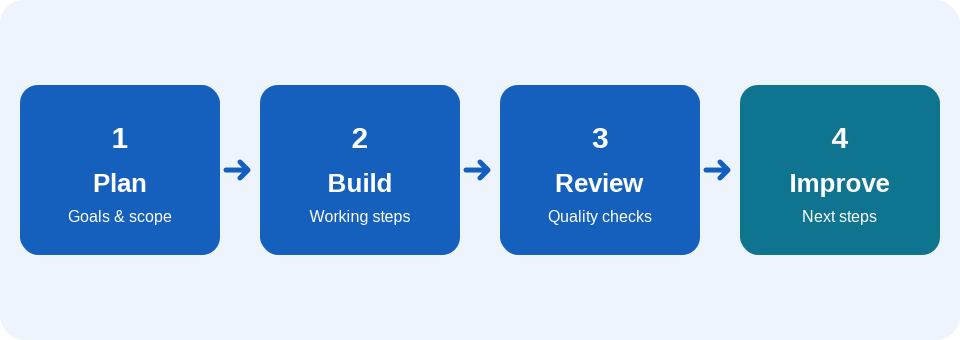
A shared goal moves through planning, delivery, and review.
Sustainability & Community: A shared goal moves through planning, delivery, and review.

Sustainability and community

SAHAYA LLC principles for efficient technology delivery, responsible data handling, and supervised community and student learning opportunities.

Download Sustainability and community (PowerPoint)

Read the English video transcript

[Welcome]
Doing well means leaving things better. Welcome to SAHAYA. In this briefing, we look at sustainability and community.

[Audience and format]
This briefing is written for the Chief Executive Officer and community partners. Like every SAHAYA briefing, it follows four steps: Situation, Task, Action and Result. It is a sample scenario, not a client result or a guarantee.

[Situation]
Situation. Organizations increasingly ask partners about their impact. Leaders want to know how a company treats people, resources and the community.

[Task]
Task. Describe how SAHAYA approaches responsible practices, education and community support.

[Action]
Action. Here is how SAHAYA approaches it. First, we aim to use efficient designs that avoid waste, such as right sized cloud usage. Second, we support learning by offering students real project experience. Third, we value inclusive practices, including accessible websites and respectful communication. Finally, we review our efforts and update them as we learn.

[Reference architecture]
Reference architecture. A sample reference architecture for sustainability and community has four layers. Layer one, efficiency, covering right sized resources. Layer two, education, covering guided student projects. Layer three, inclusion, covering accessibility and respect. Layer four, review, covering honest reporting and improvement.

[Result and sample ROI]
Result. In this illustrative example, a school partners with SAHAYA, and students complete a guided project that benefits a local organization. For quick reference, here is a sample of the benefits to discuss. Benefit one, lower waste through efficient design. Benefit two, opportunities for students. Benefit three, accessible experiences for more people. These are directional examples to frame a conversation. Your results depend on your starting point and agreed scope.

[Industry alignment]
Industry alignment. Public sector, education and nonprofit partners often share these priorities.

[Values and people in the loop]
Our values of Care and Growth guide how we treat people and communities. In everything we do, people stay in the loop: your team reviews the evidence, and accountable humans make the decisions.

[Next step]
If this looks like your situation, the next step is simple. Tell us what you are trying to improve, build, migrate or operate, and we will agree a focused starting point together. Visit sahaya.us, and choose Contact.

[Thank you]
Thank you for watching.

This video, including its script, voice-over, images, animation, music and design, is the property of SAHAYA LLC and/or its Affiliates and is protected by law. Any dissemination, distribution, copying, recording, reproduction or reuse, in whole or in part, without written permission is strictly prohibited.

The information shared is for general informational purposes and does not constitute a contract, offer or professional advice. Opinions expressed are those of SAHAYA LLC and may change without notice. All trademarks belong to their respective owners.

If you have received this video in error, please notify SAHAYA LLC and delete it.

(c) 2026 SAHAYA LLC. All rights reserved.

Why This Matters

  • Programs without substance. Community initiatives that exist only as a marketing page.
  • No real opportunity for students. Internship programs that offer only observation, not real contribution.
  • Resource intensive delivery. Technology work that ignores its own operational footprint.

What Is Included

  • Scoped learning. Consider supervised projects when availability and approvals allow.
  • Efficient technology use. Review resource sizing, utilization, and unnecessary operational cost.
  • Responsible data handling. Agree permitted use, access, retention, and disposal.
  • Collaboration. Discuss learning goals with schools, colleges, or community organizations.
  • Evidence-based reporting. Separate intended benefits from measured outcomes.

Practical Guidance

Learning & Safeguards

Agree learning objectives, supervision, compensation where relevant, consent, and any protections required for minors. Participation does not guarantee employment, academic credit, or access to client systems.

Safe Project Data

Prefer approved synthetic or non-sensitive data for learning. Review synthetic data for disclosure and re-identification risk; it is not automatically safe. Client information must not be used without explicit authority and appropriate controls.

Resource Efficiency

Assess utilization and right-size technology against workload requirements. Reduced cost or resource allocation does not by itself prove lower emissions. Environmental claims require a defined baseline, method, and evidence.

Reference Process

Reference Process
  1. Agree Learning Goals
  2. Approve Safe Data
  3. Supervised Delivery
  4. Review Outcomes

Agree Learning Goals → Approve Safe Data → Supervised Delivery → Review Outcomes.

This sequence is a reference for discussion. Responsibilities, access, timing, and delivery commitments depend on the relevant agreement or approved publication.

Getting Started

Propose a learning or community objective through the Contact form. Confirm feasibility, roles, safeguarding, data permissions, and outcome measures before committing participants or resources.

Industry Considerations

sustainability community: Industry Considerations
IndustryPotential learning context
EducationSupervised project objectives and safeguarding
Public sectorWorkforce development priorities
TechnologyFoundational technical skills
Retail and manufacturingLocal operating and data challenges

Sector examples identify context to assess, not verified customer engagements or a compliance conclusion.

Illustrative Value Measures

sustainability community: Illustrative Value Measures
MeasureIllustrative targetPossible evidence
Completion of agreed learning tasksAssessed for the program scopeSupervised project review
Skills developmentReviewed against the starting pointParticipant feedback and work review
Resource efficiencyEvaluated against workload needsUtilization and cost evidence

Illustration only. These measures are not verified results, guaranteed returns, or evidence that tracking is currently implemented. Agree appropriate evidence, permissions, and a baseline before measurement.

Dependencies & Safeguards

Confirm scope, ownership, permissions, and available evidence. Do not treat an informational page as confirmation of a live feed, formal credential, available program place, or completed request.

Frequently Asked Questions

How can a school or college discuss an initiative?

Use the Contact page with proposed learning goals and participant requirements. A request does not establish a partnership or available program place.

Can students use client data?

Learning should use approved synthetic or non-sensitive data. Any exceptional use of client information requires explicit authority and controls.

Is an internship paid?

Availability, compensation, working conditions, and applicable requirements are agreed for the specific program before participation.

Next Step

Discuss a scoped community or learning initiative through the Contact page.

Related: Careers | Project-Based Learning | Synthetic Data Studio