Why This Matters To Your Leadership Team
- Late discovered bugs. Problems are found by customers instead of by tests.
- Slow, manual testing. Every release is delayed by days of manual checking.
- No confidence in changes. Teams are afraid to change code because nothing catches what breaks.
Risk-based tests and explicit release gates can expose defects earlier while preserving manual review where needed.
What Is Included
The following are scope options, not automatic inclusions. Confirm availability, responsibilities, and acceptance criteria in the agreement.
- Test strategy. Choose unit, integration, end-to-end, and manual checks against actual risks.
- Automated test suites. Define trigger points, representative cases, test data, and failure handling.
- Security scanning. Agree code, dependency, container, and other checks applicable to the system.
- Performance testing. Test representative volume, latency, capacity, and recovery requirements.
- Quality metrics. Track agreed coverage, defect, escaped-defect, and change-failure measures.
Practical Delivery Considerations
Risk & Coverage
Prioritize critical workflows, integrations, negative cases, accessibility, and recovery. Choose tests based on their ability to reveal relevant failures, not an arbitrary coverage percentage.
Pipeline & Evidence
Define test environments, safe synthetic or approved data, triggers, security checks, and release gates. Record failures and authorized exceptions explicitly; a passing pipeline is not proof of complete correctness or security.
Performance & Manual Review
Use representative loads, realistic dependencies, and measured thresholds. Include manual usability and accessibility checks where needed; automated results alone do not establish WCAG conformance, legal compliance, or safety certification.
Reference Delivery Process
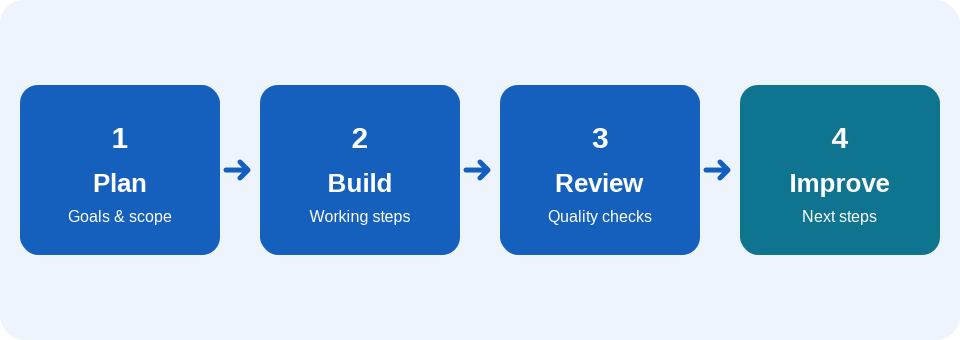
The diagram is a reference sequence of validation stages, not a testing-pyramid illustration or a guarantee of coverage. Integrate applicable checks into supported delivery tools with explicit failure and release decisions.
- Unit Tests
- Integration Tests
- Security Scan
- End To End Tests
Unit Tests → Integration Tests → Security Scan → End To End Tests.
This is a reference sequence. Access, staffing, timing, integrations, and service commitments follow the agreed engagement scope.
Getting Started
Define the outcome, baseline, affected systems, owners, access prerequisites, and constraints. Agree deliverables, measures, timeline, and commercial terms before work begins. Start with a focused assessment or pilot where appropriate; no universal delivery schedule applies.
How This Aligns With Current Industry Practice
Quality requirements differ by how much risk a defect carries.
| Industry | How this applies |
|---|---|
| Financial services | Rigorous testing ahead of regulatory reporting releases |
| Healthcare | Assess patient-facing accessibility and safety requirements with authorized specialists |
| Retail | Load testing ahead of peak shopping events |
| Technology | Fast, automated testing that supports frequent releases |
Delivery Principles
- Accountability. Named owners and clear decision rights.
- Evidence. Defined baselines, acceptance criteria, and explicit exceptions.
- Maintainability. Documented handover and operating responsibilities.
- Value for investment. Scope and commercial terms aligned to the decision or outcome.
Sample Return On Investment
The following are illustrative business-case measures, not verified client results or guaranteed returns.
| Measure | Illustrative target | How we track it |
|---|---|---|
| Defects found after release | Significantly fewer | Escaped defect rate |
| Manual testing time per release | Sharply reduced | Hours per release cycle |
| Change failure rate | Lower | DORA change failure rate |
Illustration only, based on assumed inputs. We build the real business case with your team during discovery, using your own baseline, and we report against it honestly, including where results fall short of the target.
Dependencies & Safeguards
Confirm system access, source quality, client approvals, specialist availability, provider dependencies, and scope boundaries early. Record unresolved risks and escalate failures explicitly. Industry examples identify requirements to assess, not certifications or evidence of completed client engagements.
Frequently Asked Questions
Do you replace our QA team?
No, typically we work alongside your team, building automation and practices that make everyone more effective.
How much test coverage is enough?
We target coverage where it reduces real risk, not an arbitrary percentage, focusing first on the paths that matter most to the business.
Can this work with our existing pipeline?
Assess whether existing CI/CD tools support the required checks, evidence, and gates before deciding whether changes are needed.
How is pricing structured?
Pricing depends on scope: a fixed price for well defined work, a dedicated team on a monthly basis for ongoing capacity, or a managed service with agreed service levels for continuous operation. We agree the model and the number together during scoping, before any commitment is made.
Can we start with something smaller before committing to a full engagement?
A focused assessment or pilot may be appropriate where feasible. Agree its scope, evidence, availability, and decision gates before committing to a broader program.
Next Step
Tired of finding bugs after your customers do? Reach us through the solution inquiry page.
Related: Software engineering | Cloud modernization | Consulting engagements