Why This Matters To Your Leadership Team
- Slow, outdated sites. Visitors leave before the page even finishes loading.
- Hard to update. Every small text change requires calling a developer.
- Invisible to search. The site exists, but nobody finds it through a search engine.
A scoped build can improve these foundations and define how your team maintains them.
What Is Included
The following are scope options, not automatic inclusions. Confirm availability, responsibilities, and acceptance criteria in the agreement.
- Design aligned to your brand. A professional look that reflects how you want to be seen.
- Content management system. So your team can update pages without a developer.
- Mobile and accessibility ready. Supported devices and accessibility criteria are agreed and assessed.
- Search engine foundations. Structure and metadata that help you get found.
- Analytics setup. Visibility into how visitors actually use your site.
Practical Delivery Considerations
Content & Design
Define the audience, page hierarchy, brand rules, and publishing responsibilities. Select a CMS or document-based workflow appropriate to your team's skills; a CMS is not included automatically.
Performance & Accessibility
Agree supported browsers, device sizes, performance measures, and the accessibility assessment scope. Test keyboard use, focus, forms, content structure, and reflow. Automated checks alone do not establish WCAG, ADA, or Section 508 compliance.
Search & Measurement
Review titles, descriptions, canonical URLs, internal links, and crawlability. Analytics requires an agreed purpose, privacy notice, and consent where applicable. Neither a site build nor technical SEO guarantees traffic or leads.
Reference Delivery Process
- Discover & Design
- Build Cms Site
- Test & Optimize
- Launch & Train
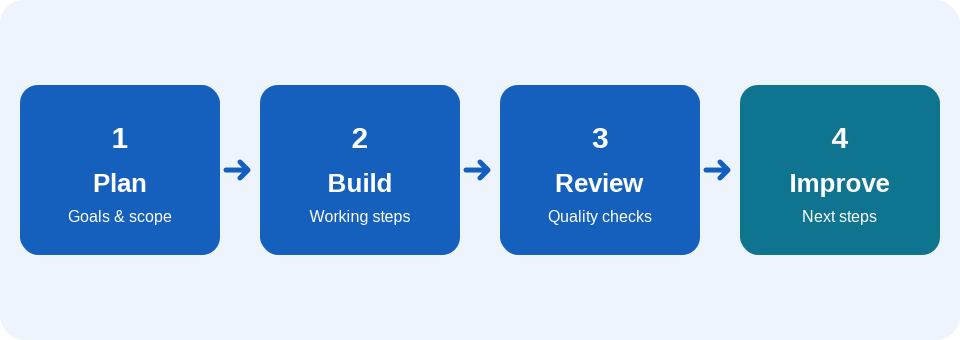
Discover & Design → Build Cms Site → Test & Optimize → Launch & Train.
This is a reference sequence. Access, staffing, timing, integrations, and service commitments follow the agreed engagement scope.
Getting Started
Define the outcome, baseline, affected systems, owners, access prerequisites, and constraints. Agree deliverables, measures, timeline, and commercial terms before work begins. Start with a focused assessment or pilot where appropriate; no universal delivery schedule applies.
How This Aligns With Current Industry Practice
Website priorities shift depending on how your business uses the site.
| Industry | How this applies |
|---|---|
| Retail | Fast, conversion focused product and category pages |
| Financial services | Trust signals and clear compliance friendly content |
| Technology | Developer friendly documentation and clear product pages |
| Public sector | Accessible, multilingual friendly citizen facing pages |
Delivery Principles
- Accountability. Named owners and clear decision rights.
- Evidence. Defined baselines, acceptance criteria, and explicit exceptions.
- Maintainability. Documented handover and operating responsibilities.
- Value for investment. Scope and commercial terms aligned to the decision or outcome.
Sample Return On Investment
The following are illustrative business-case measures, not verified client results or guaranteed returns.
| Measure | Illustrative target | How we track it |
|---|---|---|
| Page load speed | Meets good Core Web Vitals benchmarks | Speed testing tools |
| Time to update content | Minutes instead of a developer request | Time to publish a change |
| Organic search visibility | Growing over time with a proper foundation | Search ranking and organic traffic |
Illustration only, based on assumed inputs. We build the real business case with your team during discovery, using your own baseline, and we report against it honestly, including where results fall short of the target.
Dependencies & Safeguards
Confirm system access, source quality, client approvals, specialist availability, provider dependencies, and scope boundaries early. Record unresolved risks and escalate failures explicitly. Industry examples identify requirements to assess, not certifications or evidence of completed client engagements.
Frequently Asked Questions
Can we update the site ourselves after launch?
Yes, that is a core goal. We choose a content management system your team can use confidently.
Do you also handle hosting?
Yes, hosting is offered as a separate, related service, or we can work with your existing host.
How long does a typical build take?
Timing depends on scope, content readiness, approvals, and integrations. Confirm a delivery schedule during discovery.
How is pricing structured?
Pricing depends on scope: a fixed price for well defined work, a dedicated team on a monthly basis for ongoing capacity, or a managed service with agreed service levels for continuous operation. We agree the model and the number together during scoping, before any commitment is made.
Can we start with something smaller before committing to a full engagement?
Yes. Many clients start with a focused consulting engagement or a single pilot to prove the approach before scaling it further. We would rather earn a larger engagement through results than ask you to commit to one upfront.
Next Step
Ready for a website that reflects how good your business actually is? Reach us through the service inquiry page.
Related: Website hosting | Search optimization | Web application development