Why This Matters To Your Leadership Team
- High legacy run cost. Licenses, hardware, and specialist support consume budget every year.
- Fragile systems. Changes are slow and risky because nobody fully understands the old code.
- Growing security exposure. Old platforms fall behind on patching and modern controls.
Staged assessment and decision gates can reduce migration exposure without assuming every workload should move.
What Is Included
The following are scope options, not automatic inclusions. Confirm availability, responsibilities, and acceptance criteria in the agreement.
- Retain. Keep workloads where migration risk or economics do not support a change.
- Rehost. Assess a move with limited changes, including compatibility and operational risks.
- Replatform. Evaluate targeted changes to supported cloud capabilities.
- Refactor. Redesign components where benefits justify complexity and investment.
- Repurchase. Compare commercial alternatives, integration, licensing, and migration constraints.
- Retire. Decommission only with approved dependency, retention, and recovery decisions.
Practical Delivery Considerations
Portfolio & Options
Inventory workloads, dependencies, ownership, support status, and current costs. Compare retain and retire options alongside migration; rehosting is not inherently low risk or cheaper.
Landing Zone & Waves
Agree identity, network boundaries, residency, logging, deployment approval, and cost controls before moving workloads. Plan waves and validate compatibility against representative business processes.
Continuity & Retirement
Define downtime windows, backups, reconciliation, recovery feasibility, and irreversible changes. Parallel operation is used only where feasible. Require explicit sign-off before retiring legacy services or retained data.
Reference Delivery Process
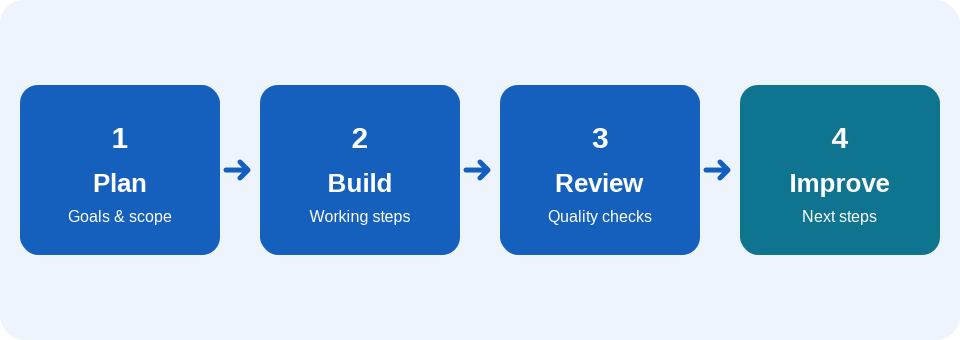
The reference sequence assesses workloads, establishes agreed platform controls, moves approved waves, and reviews operating outcomes. Keeping legacy systems available as a fallback requires a feasible, funded, and approved recovery plan.
- Assess
- Landing Zone
- Migrate Waves
- Optimize
Assess → Landing Zone → Migrate Waves → Optimize.
This is a reference sequence. Access, staffing, timing, integrations, and service commitments follow the agreed engagement scope.
Getting Started
Define the outcome, baseline, affected systems, owners, access prerequisites, and constraints. Agree deliverables, measures, timeline, and commercial terms before work begins. Start with a focused assessment or pilot where appropriate; no universal delivery schedule applies.
How This Aligns With Current Industry Practice
Modernization priorities vary by regulatory and operational pressure.
| Industry | How this applies |
|---|---|
| Financial services | Assess core-reporting modernization and applicable audit evidence |
| Public sector | Plan staged modernization around citizen-service continuity requirements |
| Healthcare | Careful migration of records with privacy controls preserved |
| Manufacturing | Plan plant-reporting changes around production windows and recovery limits |
Delivery Principles
- Accountability. Named owners and clear decision rights.
- Evidence. Defined baselines, acceptance criteria, and explicit exceptions.
- Maintainability. Documented handover and operating responsibilities.
- Value for investment. Scope and commercial terms aligned to the decision or outcome.
Sample Return On Investment
The following are illustrative business-case measures, not verified client results or guaranteed returns.
| Measure | Illustrative target | How we track it |
|---|---|---|
| Legacy platform run cost | 15 to 30 percent lower after retirement | Annual platform cost |
| Time to implement a system change | Significantly faster | Lead time for changes |
| Security findings on modernized systems | Fewer | Audit and scan results |
Illustration only, based on assumed inputs. We build the real business case with your team during discovery, using your own baseline, and we report against it honestly, including where results fall short of the target.
Dependencies & Safeguards
Confirm system access, source quality, client approvals, specialist availability, provider dependencies, and scope boundaries early. Record unresolved risks and escalate failures explicitly. Industry examples identify requirements to assess, not certifications or evidence of completed client engagements.
Frequently Asked Questions
Do we have to move everything at once?
No, and we recommend against it. We modernize in waves, proving the pattern on a low risk workload first.
Which cloud platform is right for us?
It depends on your existing tools, team skills, and workloads. We help you decide rather than defaulting to one platform.
What happens to the legacy system during migration?
Agree whether parallel operation is feasible, how it is funded, and when recovery remains possible. Retire legacy systems only after approved acceptance, dependency, and retention decisions.
How is pricing structured?
Pricing depends on scope: a fixed price for well defined work, a dedicated team on a monthly basis for ongoing capacity, or a managed service with agreed service levels for continuous operation. We agree the model and the number together during scoping, before any commitment is made.
Can we start with something smaller before committing to a full engagement?
A focused assessment or pilot may be appropriate where feasible. Agree its scope, evidence, availability, and decision gates before committing to a broader program.
Next Step
Ready to lower your legacy platform costs? Reach us through the solution inquiry page.
Related: Platform optimization | Data migration | Software engineering