Why This Matters To Your Leadership Team
- Outdated documentation. What is written no longer matches what is actually running.
- Too technical, or not technical enough. Documentation misses the audience that actually needs to read it.
- Missing entirely. Some systems were delivered with no documentation at all.
We treat documentation as a deliverable, not an afterthought, on every engagement.
What Is Included
Our documentation typically includes the following.
- Architecture overviews. A clear picture of how the system is structured and why.
- Operational runbooks. Step by step guidance for common operational tasks.
- API references. Specifications for any interfaces we build.
- Onboarding guides. Material to help new team members get oriented quickly.
- Change history. A record of what changed and when, so context is never lost.
Practical Guidance
Architecture & Reference
Record system boundaries, dependencies, architecture decisions, interface contracts, and supported versions. Separate executive context from technical reference details.
Operations & Onboarding
Document access prerequisites, routine tasks, monitoring, incident escalation, rollback, and recovery. Provide an onboarding path without embedding secrets or sensitive client data.
Ownership & Change History
Assign a documentation owner and record versioned changes. Include documentation review in acceptance criteria and agree who maintains it after handover.
How SAHAYA LLC Delivers It
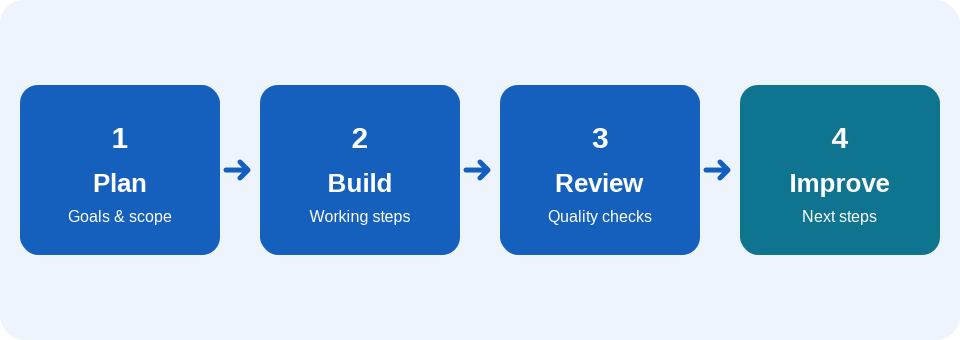
Documentation is structured to serve different readers, from an executive overview down to operational detail.
- Overview
- Architecture
- Operations
- Reference
Overview → Architecture → Operations → Reference.
Figure: Reference documentation structure delivered with SAHAYA projects.
We keep documentation alongside the code and configuration it describes, so it stays current as the system changes.
Getting Started
Identify the audiences and supported system version. Agree architecture decisions, operating tasks, reference interfaces, owners, and acceptance criteria. Review documentation alongside delivery changes; ongoing updates depend on the support scope.
How This Aligns With Current Industry Practice
Documentation depth is adjusted to sector requirements.
| Industry | How this applies |
|---|---|
| Financial services | Documentation that supports audit and control evidence |
| Healthcare | Documentation that supports compliance reviews |
| Public sector | Documentation that supports procurement and handover requirements |
| Technology | Developer focused documentation for fast onboarding |
Our Delivery Principles
- Accountability. Name owners and make decision rights clear.
- Evidence. Agree meaningful measures and review results against the baseline.
- Durability. Support maintainable foundations and knowledge transfer.
- Value for investment. Match scope and commercial terms to the outcome.
Sample Return On Investment
Good documentation reduces onboarding time and the risk of losing knowledge when someone leaves.
| Measure | Illustrative target | How we track it |
|---|---|---|
| Time to onboard a new team member to a system | Reduced through clear documentation | Onboarding time tracking |
| Knowledge loss when staff transition | Reduced | Post-transition incident rates |
| Documentation currency | Kept aligned with the live system | Documentation review cadence |
Illustration only, based on assumed inputs. We build the real business case with your team during discovery, using your own baseline, and we report against it honestly, including where results fall short of the target.
Dependencies & Safeguards
Confirm ownership, permissions, available evidence, and the relevant agreement before proceeding. Escalate missing information or approval explicitly rather than assuming it is available.
Frequently Asked Questions
Is documentation included with every engagement?
Yes, we treat it as a standard deliverable, scoped to the size of the engagement.
Who is the documentation written for?
We write for the people who will actually maintain the system, adjusting technical depth accordingly.
Do you update documentation after changes?
Yes, as part of ongoing support or managed services engagements.
Next Step
Inherited a system with little or no documentation? Reach us through the Contact page.
Related: Developer guides | Resource library | Managed services