Routing, integrations, reporting and service expectations are agreed for each process. These are configured delivery capabilities, not a claim that every workflow or integration is already available in this website.
This page explains what Workflow applications covers, how SAHAYA LLC delivers it, what to expect in return, and how it fits your industry. Read on for the detail, or use the Contact link at the end to start a conversation.
Why This Matters To Your Leadership Team
- Lost approvals. A request sits in someone's inbox, forgotten.
- No visibility. Nobody can say where a request stands without asking around.
- Re-entered data. The same information is typed into a spreadsheet, then an email, then a system.
A workflow application removes the guesswork and the re-typing in one step.
These pressures rarely resolve on their own. Left alone, they tend to compound: a small workaround becomes the normal way of working, and by the time it is visible at the leadership level, the cost of the underlying problem has grown well beyond what it would have taken to address it early.
What Is Included
Our workflow applications typically include the following.
- Digitized forms. Structured intake that replaces free form email requests.
- Configurable approval routing. Requests go to the right approver automatically.
- Status tracking. Anyone with access can see where a request stands.
- Integration with source systems. Approved requests flow into the systems that need them.
- Reporting. Visibility into volume, cycle time, and bottlenecks.
How We Approach Each Part Of The Work
Rather than treat these as a checklist, we sequence them so each step builds on evidence from the last. Below is what that looks like in practice.
Digitized Forms
Structured intake that replaces free form email requests. We scope this against your current state first, so it reflects what your organization actually needs rather than a generic template. A named person on our team is accountable for this specific piece throughout delivery.
Configurable Approval Routing
Requests go to the right approver automatically. This is one of the areas clients most often underestimate going in, and one where a little extra care early pays off through the rest of the engagement. A named person on our team is accountable for this specific piece throughout delivery.
Status Tracking
Anyone with access can see where a request stands. We size this to the scale of your engagement. A pilot gets a lighter version; a full program gets the complete treatment. A named person on our team is accountable for this specific piece throughout delivery.
Integration With Source Systems
Approved requests flow into the systems that need them. This work is done alongside your team where possible, so knowledge transfers naturally rather than needing a separate handover step later. A named person on our team is accountable for this specific piece throughout delivery.
Reporting
Visibility into volume, cycle time, and bottlenecks. We treat this as a living part of the engagement, revisited as circumstances change rather than finalized once and left alone. A named person on our team is accountable for this specific piece throughout delivery.
How SAHAYA LLC Delivers It
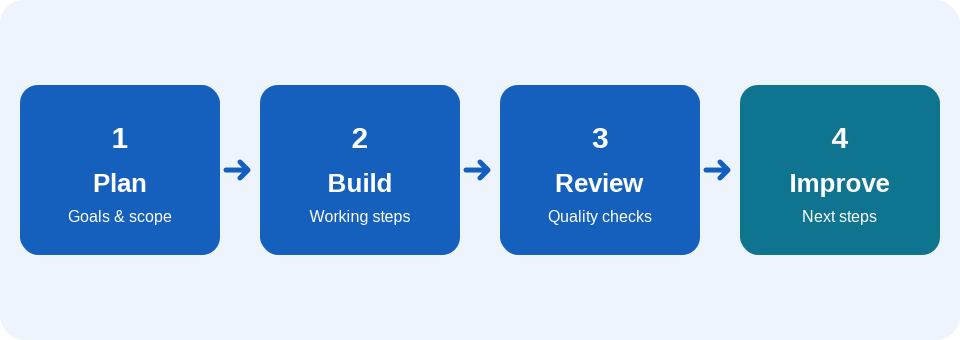
Requests move through a defined path from intake to completion, with status visible at every step.
- Request Intake
- Route For Approval
- Process & Integrate
- Track & Report
Request Intake → Route For Approval → Process & Integrate → Track & Report. Scope, access and acceptance criteria are agreed for each engagement.
Figure: Reference workflow application pattern.
We build these as standalone applications or on low code platforms such as Microsoft Power Platform, depending on the complexity and scale of the process.
We keep this pattern deliberately simple to explain, because a design your own team can describe back to us is a design your team can also maintain after we hand it over. Complexity is added only where the business need justifies it, never by default.
Getting Started: What The First Weeks Look Like
Most engagements in this area follow a similar early rhythm, regardless of scope.
- Week 1 to 2, discovery. We review your current state, talk to the people closest to the problem, and confirm the specific outcome workflow applications should achieve for you.
- Week 3 to 4, design. We agree the approach, the plan, and the measurable business case, in writing, before any significant build work begins.
- Following weeks, delivery. We build or implement in short, visible increments, so you see progress regularly rather than waiting for a single big reveal.
- At handover, proof and transfer. We show the agreed measures against your baseline, document what we built, and make sure your team can run it without us if that is what you choose.
How This Aligns With Current Industry Practice
Workflow needs vary widely by process type.
| Industry | How this applies |
|---|---|
| Public sector | Permit and license application workflows |
| Manufacturing | Maintenance request and approval workflows |
| Financial services | Exception and approval workflows with audit trails |
| Retail | Vendor onboarding and purchase approval workflows |
In Public sector, permit and license application workflows. We adapt scope, evidence, and pace to reflect the standards and priorities specific to that environment, rather than applying a single generic approach across every sector.
In Manufacturing, maintenance request and approval workflows. We adapt scope, evidence, and pace to reflect the standards and priorities specific to that environment, rather than applying a single generic approach across every sector.
In Financial services, exception and approval workflows with audit trails. We adapt scope, evidence, and pace to reflect the standards and priorities specific to that environment, rather than applying a single generic approach across every sector.
In Retail, vendor onboarding and purchase approval workflows. We adapt scope, evidence, and pace to reflect the standards and priorities specific to that environment, rather than applying a single generic approach across every sector.
The Values We Bring To This Work
These values are not a slogan. They describe specific, checkable things we do differently, and we are glad to be held to them.
- Young and focused a senior team stays on your engagement instead of rotating you through junior staff.
- Trusted delivery we agree a measurable outcome before we start, and we report against it in plain language.
- Organic results we build foundations that keep paying off after the engagement ends, not dependencies that require us forever.
- Value for investment every engagement carries a stated business case, reviewed against your own numbers, not ours.
Sample Return On Investment
Workflow applications pay back through faster cycle times and fewer errors.
| Measure | Illustrative target | How we track it |
|---|---|---|
| Request cycle time | 30 to 50 percent faster | Time from request to completion |
| Status inquiry calls or emails | Sharply reduced | Contacts per request |
| Data re-entry steps | Eliminated for the digitized process | Manual steps before and after |
Illustration only, based on assumed inputs. We build the real business case with your team during discovery, using your own baseline, and we report against it honestly, including where results fall short of the target.
What Could Slow This Down
Every engagement carries some risk of delay. Here is what we watch for, and how we handle it.
- Lost approvals. Left unaddressed, this is a common source of delay. We surface it explicitly during discovery so it is planned for, not discovered mid-engagement.
- No visibility. This tends to surface once real data or real users are involved, so we build in an early checkpoint specifically to catch it sooner rather than later.
- Re-entered data. This usually traces back to a decision or approval outside our control. We flag the dependency early and agree who owns resolving it.
Frequently Asked Questions
Can this replace our current approval emails?
Yes, that is the most common starting point, and usually the fastest win.
Does this integrate with our existing systems?
Yes. We connect the workflow to the systems that need the resulting data, such as an ERP or CRM.
How long does a first workflow take to build?
A focused first workflow may be planned over six to ten weeks, depending on complexity, access and integration dependencies. The delivery schedule is confirmed during scoping rather than promised by this illustration.
How is pricing structured?
Pricing depends on scope: a fixed price for well defined work, a dedicated team on a monthly basis for ongoing capacity, or a managed service with agreed service levels for continuous operation. We agree the model and the number together during scoping, before any commitment is made.
Can we start with something smaller before committing to a full engagement?
Yes. Many clients start with a focused consulting engagement or a single pilot to prove the approach before scaling it further. We would rather earn a larger engagement through results than ask you to commit to one upfront.
Next Step
Have a process still running on email and spreadsheets? Reach us through the Contact page.
Related: Software engineering | API & web services | Administrative support