Loading page details.
Back Home
Managed Services: Ongoing ownership, not just maintenance
SAHAYA LLC managed-services engagements define accountable operation, agreed service levels, health reviews, and a prioritized improvement plan. Coverage, ownership boundaries, reporting cadence, dependencies, and commercial terms are specified in the agreement.
Discuss Service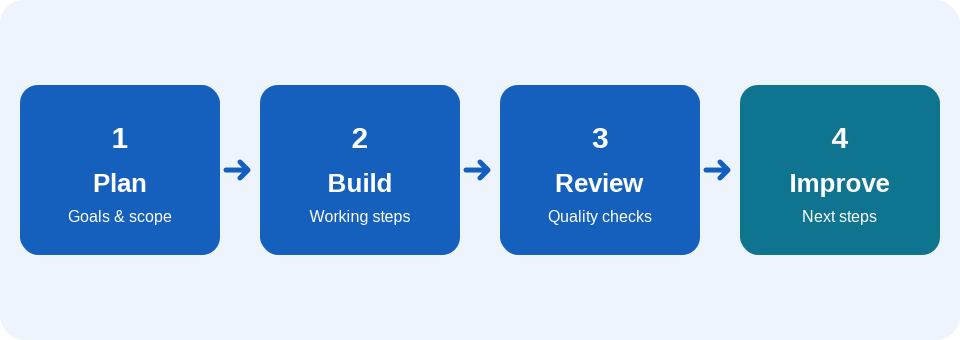
Managed services
Managed-services plans define accountable operations, service levels, health reviews, and prioritized improvements.
Read the English video transcript
[Welcome]
Let a trusted partner run the routine, so your team builds the future. Welcome to SAHAYA. In this briefing, we look at managed services.
[Audience and format]
This briefing is written for the Chief Operating Officer, Chief Technology Officer and Chief Financial Officer. Like every SAHAYA briefing, it follows four steps: Situation, Task, Action and Result. It is a sample scenario, not a client result or a guarantee.
[Situation]
Situation. A company's data and digital operations depend on a few overstretched people. Routine work crowds out improvement, and a single resignation could create a crisis.
[Task]
Task. Provide ongoing managed support for defined services, with clear scope, service levels and reporting.
[Action]
Action. Here is how SAHAYA approaches it. First, we document what is in scope, the service levels, and the responsibilities of each side. Second, we transition knowledge, access and tooling in stages, with shadowing and review. Third, we operate the services, monitor health, and handle requests through a clear process. Finally, we report monthly on service levels, incidents and improvements, and we review the plan each quarter.
[Reference architecture]
Reference architecture. A sample reference architecture for managed services has four layers. Layer one, scope, covering services, levels and responsibilities. Layer two, transition, covering knowledge, access and tooling. Layer three, operate, covering monitoring, requests and incidents. Layer four, improve, covering monthly reports and quarterly reviews.
[Result and sample ROI]
Result. In this illustrative example, leaders receive a monthly report, and the internal team spends its time on projects. For quick reference, here is a sample of the benefits to discuss. Benefit one, predictable monthly cost for defined services. Benefit two, reduced key person risk. Benefit three, internal teams focus on improvement. These are directional examples to frame a conversation. Your results depend on your starting point and agreed scope.
[Industry alignment]
Industry alignment. Healthcare, manufacturing and retail teams often use managed services for data operations and website support.
[Values and people in the loop]
Our value of Accountability appears in service levels you can measure. In everything we do, people stay in the loop: your team reviews the evidence, and accountable humans make the decisions.
[Next step]
If this looks like your situation, the next step is simple. Tell us what you are trying to improve, build, migrate or operate, and we will agree a focused starting point together. Visit sahaya.us, and choose Contact.
[Thank you]
Thank you for watching.
This video, including its script, voice-over, images, animation, music and design, is the property of SAHAYA LLC and/or its Affiliates and is protected by law. Any dissemination, distribution, copying, recording, reproduction or reuse, in whole or in part, without written permission is strictly prohibited.
The information shared is for general informational purposes and does not constitute a contract, offer or professional advice. Opinions expressed are those of SAHAYA LLC and may change without notice. All trademarks belong to their respective owners.
If you have received this video in error, please notify SAHAYA LLC and delete it.
(c) 2026 SAHAYA LLC. All rights reserved.