Why This Matters To Your Leadership Team
- Unexpected downtime. The site goes down and nobody notices until a customer complains.
- Unpatched security gaps. Hosting infrastructure falls behind on updates over time.
- No backup plan. A failure or attack could mean starting from nothing.
Defined operational responsibilities help manage these risks; hosting does not eliminate them.
What Is Included
The following are scope options, not automatic inclusions. Confirm availability, responsibilities, and acceptance criteria in the agreement.
- Uptime monitoring. Agree checks, alert routing, and coverage; detection before visitor impact is not guaranteed.
- Security patching. Infrastructure kept current against known vulnerabilities.
- Automated backups. Agree backup frequency, retention, restoration tests, and recovery objectives.
- TLS and encryption. Configure and test HTTPS and agreed certificate-renewal controls.
- Performance tuning. Caching and configuration for fast page loads.
Practical Delivery Considerations
Platform & Responsibility
Select hosting against workload, geography, cost, and platform support. Document the boundary between provider-managed infrastructure and application responsibilities. Platform names are options to evaluate, not vendor credentials.
Monitoring & Recovery
Agree alert routing, coverage hours, patch responsibilities, backup frequency, retention, and recovery objectives. Demonstrate restoration before treating a backup as a recovery solution. Static-site deployments and data-bearing applications may need different recovery plans.
Availability & Change
Agree TLS, access controls, deployment approval, rollback, and service-level measures. Monitoring cannot guarantee that every outage is detected before a visitor notices, and no universal uptime or incident-resolution promise applies.
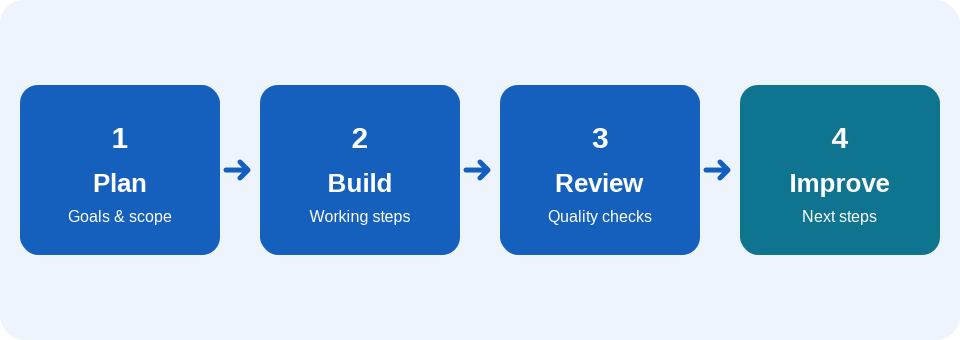
Reference Delivery Process
- Cdn & Firewall
- Hosting Platform
- Monitoring
- Backups
Cdn & Firewall → Hosting Platform → Monitoring → Backups.
This is a reference sequence. Access, staffing, timing, integrations, and service commitments follow the agreed engagement scope.
Getting Started
Define the outcome, baseline, affected systems, owners, access prerequisites, and constraints. Agree deliverables, measures, timeline, and commercial terms before work begins. Start with a focused assessment or pilot where appropriate; no universal delivery schedule applies.
How This Aligns With Current Industry Practice
Hosting requirements vary by how critical uptime is to the business.
| Industry | How this applies |
|---|---|
| Retail | Hosting sized for seasonal traffic peaks |
| Financial services | Hosting with strong security and audit logging |
| Technology | Hosting that scales with growing product usage |
| Public sector | Hosting that supports accessibility and uptime expectations |
Delivery Principles
- Accountability. Named owners and clear decision rights.
- Evidence. Defined baselines, acceptance criteria, and explicit exceptions.
- Maintainability. Documented handover and operating responsibilities.
- Value for investment. Scope and commercial terms aligned to the decision or outcome.
Sample Return On Investment
The following are illustrative business-case measures, not verified client results or guaranteed returns.
| Measure | Illustrative target | How we track it |
|---|---|---|
| Site uptime | High availability, tracked monthly | Uptime monitoring reports |
| Time to recover from an incident | Fast, using tested backups | Recovery time in drills |
| Security patching lag | Minimal, kept current | Patch cadence tracking |
Illustration only, based on assumed inputs. We build the real business case with your team during discovery, using your own baseline, and we report against it honestly, including where results fall short of the target.
Dependencies & Safeguards
Confirm system access, source quality, client approvals, specialist availability, provider dependencies, and scope boundaries early. Record unresolved risks and escalate failures explicitly. Industry examples identify requirements to assess, not certifications or evidence of completed client engagements.
Frequently Asked Questions
Can you host a site you did not build?
Yes, we can take over hosting for an existing site after a review.
What happens if the site goes down?
Use the contracted escalation path. Detection, response, mitigation, and recovery follow the agreed coverage and platform responsibilities.
Do you provide backups?
Backup and restoration requirements are agreed for the platform, with evidence from the planned recovery tests.
How is pricing structured?
Pricing depends on scope: a fixed price for well defined work, a dedicated team on a monthly basis for ongoing capacity, or a managed service with agreed service levels for continuous operation. We agree the model and the number together during scoping, before any commitment is made.
Can we start with something smaller before committing to a full engagement?
Yes. Many clients start with a focused consulting engagement or a single pilot to prove the approach before scaling it further. We would rather earn a larger engagement through results than ask you to commit to one upfront.
Next Step
Want your website's uptime to be someone else's responsibility? Reach us through the service inquiry page.
Related: Website building | Domain creation | Priority operations support