Back Home

Resource Library

Browse SAHAYA LLC guidance on data, software, AI, digital operations, and learning. The linked pages provide practical discussion points and reference processes; project-specific documentation may be restricted to authorized teams.

Contact
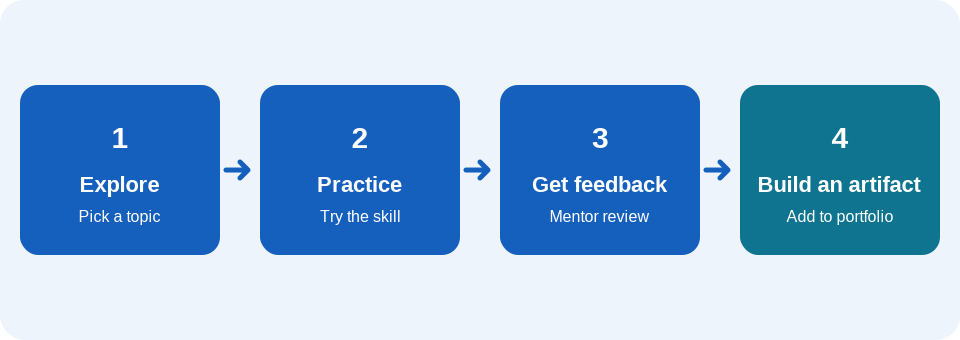
Explore, practice, receive feedback, and build on what you learn.
Resource Library: Explore, practice, receive feedback, and build on what you learn.

Resource library

Browse SAHAYA LLC documentation, developer guidance, data governance, industry perspective, training, and event information.

Download Resource library (PowerPoint)

Read the English video transcript

[Welcome]
Practical guidance, organized so you can find it in minutes. Welcome to SAHAYA. In this briefing, we look at resource library.

[Audience and format]
This briefing is written for the Chief Data and Analytics Officer and Chief Technology Officer. Like every SAHAYA briefing, it follows four steps: Situation, Task, Action and Result. It is a sample scenario, not a client result or a guarantee.

[Situation]
Situation. A leader needs a quick, reliable answer on a data or platform topic. Search results are noisy, vendor pages disagree, and the team has no shared place for trusted guidance.

[Task]
Task. Provide an organized library of guides, checklists and reference material that executives and teams can use immediately.

[Action]
Action. Here is how SAHAYA approaches it. First, we organize resources by topic, such as data, platforms, web and operations, and by audience, such as executive and practitioner. Second, we write each resource in plain language, with a clear purpose, a short summary and practical steps. Third, we review resources for accuracy against recognized standards and update them on a schedule. Finally, we invite feedback and use it to improve and add new guides.

[Reference architecture]
Reference architecture. A sample reference architecture for resource library has four layers. Layer one, topics, covering data, platforms, web and operations. Layer two, formats, covering guides, checklists and templates. Layer three, quality, covering review against recognized standards. Layer four, feedback, covering reader input and updates.

[Result and sample ROI]
Result. In this illustrative example, a manager finds a checklist in two minutes and shares it with the team. For quick reference, here is a sample of the benefits to discuss. Benefit one, faster answers to common questions. Benefit two, a shared vocabulary across teams. Benefit three, less time spent searching and comparing sources. These are directional examples to frame a conversation. Your results depend on your starting point and agreed scope.

[Industry alignment]
Industry alignment. Resources cover retail, healthcare, financial services, public sector and other industries, with notes on regulations where relevant.

[Values and people in the loop]
Our value of Clarity means resources written for busy people. In everything we do, people stay in the loop: your team reviews the evidence, and accountable humans make the decisions.

[Next step]
If this looks like your situation, the next step is simple. Tell us what you are trying to improve, build, migrate or operate, and we will agree a focused starting point together. Visit sahaya.us, and choose Contact.

[Thank you]
Thank you for watching.

This video, including its script, voice-over, images, animation, music and design, is the property of SAHAYA LLC and/or its Affiliates and is protected by law. Any dissemination, distribution, copying, recording, reproduction or reuse, in whole or in part, without written permission is strictly prohibited.

The information shared is for general informational purposes and does not constitute a contract, offer or professional advice. Opinions expressed are those of SAHAYA LLC and may change without notice. All trademarks belong to their respective owners.

If you have received this video in error, please notify SAHAYA LLC and delete it.

(c) 2026 SAHAYA LLC. All rights reserved.

Why This Matters

  • Scattered information. Useful guidance about a topic is spread across many unrelated sources.
  • Too much marketing, too little substance. Vendor content often sells a product instead of explaining the problem.
  • Hard to find what is relevant. A general search returns results that do not match your situation.

What Is Included

  • Documentation. Architecture, operating, and handover considerations.
  • Developer guidance. Contracts, integration, testing, and release checkpoints.
  • Governance. Ownership, quality, access, and review practices.
  • Industry perspective. Decisions, applicability, and evidence.
  • Learning resources. Training and event information.

Practical Guidance

Browse Available Pages

Apply Guidance Responsibly

Use reference processes as a starting point, not a ready-made implementation or compliance conclusion. Check platform version, sector requirements, ownership, and approval boundaries before adopting a pattern.

Project-Specific Material

Client documentation, configurations, and data remain subject to the engagement's access permissions. Public guidance does not authorize access to restricted workspaces.

Reference Process

Reference Process
  1. Browse By Topic
  2. Read The Guidance
  3. Review Applicability
  4. Agree Your Next Step

Browse By Topic → Read The Guidance → Review Applicability → Agree Your Next Step.

This sequence is a reference for discussion. Responsibilities, access, timing, and delivery commitments depend on the relevant agreement or approved publication.

Getting Started

Choose a topic from the linked resources, identify the decision or task you need to support, and discuss any gaps with your team. Use the Contact form to request a topic or scoped assistance.

Industry Considerations

resource library: Industry Considerations
IndustryHow this applies
Financial servicesGuides on regulatory reporting and risk data
HealthcareGuides on interoperability and privacy by design
ManufacturingGuides on plant to enterprise data patterns
Public sectorGuides on modernization and accessibility

Sector examples identify context to assess, not verified customer engagements or a compliance conclusion.

Illustrative Value Measures

resource library: Illustrative Value Measures
MeasureIllustrative targetHow we track it
Time to understand a new topicReduced through structured guidesReader feedback and usage tracking
Repeat visits to the libraryGrowing, indicating real usefulnessSite analytics
Resources referenced during client engagementsFrequent, indicating practical valueInternal usage tracking

Illustration only. These measures are not verified results, guaranteed returns, or evidence that tracking is currently implemented. Agree appropriate evidence, permissions, and a baseline before measurement.

Dependencies & Safeguards

Confirm scope, ownership, permissions, and available evidence. Do not treat an informational page as confirmation of a live feed, formal credential, available program place, or completed request.

Frequently Asked Questions

Are the public pages free to read?

Yes. Public pages do not provide access to restricted client documentation or licensed materials.

How often is material updated?

Updates depend on reviewed material. Check applicability against the system version and requirements in use.

Can I suggest a topic?

Use the Contact page with the question you would like the resource to answer.

Next Step

Browse the linked pages or request guidance through the Contact page.

Related: Documentation | Developer guides | Training & education