Why This Matters To Your Leadership Team
- Pilots that never launch. A promising demo never becomes something people actually use.
- Answers nobody can verify. An assistant gives confident answers with no way to check them.
- Unclear cost and risk. Nobody can say what this will cost at scale, or who is accountable if it is wrong.
Our approach exists to close these gaps before they become expensive problems.
What Is Included
The following are scope options, not automatic inclusions. Confirm availability, responsibilities, and acceptance criteria in the agreement.
- Use case selection. Rank value, feasibility, permitted data use, and consequential decision risks.
- Grounded generative AI. Assess retrieval from approved sources, access filtering, and verifiable citations.
- Predictive models. Evaluate forecasting, scoring, or classification against representative governed data.
- Evaluation. Define expert-reviewed test cases, error measures, and change gates.
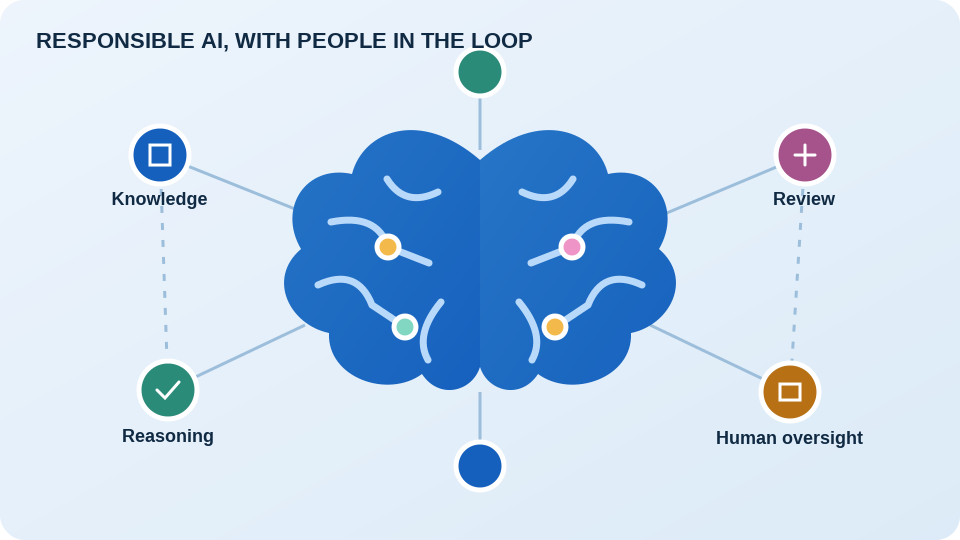
- Human oversight. Assign review, override, escalation, and supported audit-evidence responsibilities.
Practical Delivery Considerations
Data & Provider Terms
Confirm permitted use, residency, retention, logging, training terms, and access boundaries for the selected provider and service configuration. Do not submit restricted data before authorized owners approve the arrangement.
Retrieval & Evaluation
Validate retrieved sources, citation accuracy, prompt-injection exposure, hallucination rates, bias, and performance on representative questions. Retrieval and citations can still produce unsupported answers; define refusal and escalation behavior.
Human Review & Operation
Keep authorized reviewers responsible for consequential decisions and define monitoring, overrides, incident response, and versioned evaluation evidence. Assess healthcare, financial, or other high-impact uses with the relevant specialist and legal owners.
Reference Delivery Process
The reference assistant flow checks identity and access before model and retrieval steps, then evaluates a response. Assess Azure OpenAI, Amazon Bedrock, Google Vertex AI, Databricks Mosaic AI, or Snowflake Cortex against data requirements, provider terms, cost, and operational constraints. These are platform options, not partnership credentials or proof of deployment.
- User Request
- Safety & Identity
- Model + Retrieval
- Evaluate Response
User Request → Safety & Identity → Model + Retrieval → Evaluate Response.
This is a reference sequence. Access, staffing, timing, integrations, and service commitments follow the agreed engagement scope.
Getting Started
Define the outcome, baseline, affected systems, owners, access prerequisites, and constraints. Agree deliverables, measures, timeline, and commercial terms before work begins. Start with a focused assessment or pilot where appropriate; no universal delivery schedule applies.
How This Aligns With Current Industry Practice
AI use cases and risk tolerance vary by sector.
| Industry | How this applies |
|---|---|
| Financial services | Document processing and analyst assistants with strong human review |
| Healthcare | Administrative automation with clinician oversight |
| Retail | Demand forecasting and personalization on consented data |
| Manufacturing | Predictive maintenance and quality inspection support |
Delivery Principles
- Accountability. Named owners and clear decision rights.
- Evidence. Defined baselines, acceptance criteria, and explicit exceptions.
- Maintainability. Documented handover and operating responsibilities.
- Value for investment. Scope and commercial terms aligned to the decision or outcome.
Sample Return On Investment
The following are illustrative business-case measures, not verified client results or guaranteed returns.
| Measure | Illustrative target | How we track it |
|---|---|---|
| Time to first working pilot | 8 to 12 weeks | Date of first user facing release |
| Pilots reaching production | A clear majority, tracked from day one | Share of funded pilots in production |
| Knowledge and drafting task time | 20 to 40 percent saved on targeted work | Time studies before and after |
Illustration only, based on assumed inputs. We build the real business case with your team during discovery, using your own baseline, and we report against it honestly, including where results fall short of the target.
Dependencies & Safeguards
Confirm system access, source quality, client approvals, specialist availability, provider dependencies, and scope boundaries early. Record unresolved risks and escalate failures explicitly. Industry examples identify requirements to assess, not certifications or evidence of completed client engagements.
Frequently Asked Questions
Will the AI make things up?
Models may generate incorrect or unsupported answers even with retrieval and citations. Evaluate representative cases, validate sources, and require authorized human review for consequential decisions.
Is our data used to train public models?
Review the selected provider's contract, service tier, training terms, retention, and configuration before sending data. Do not assume every provider or feature excludes training; proceed only with approved terms and controls.
How long until we see results?
Agree pilot timing after reviewing use case, data access, evaluation needs, provider approval, and human-review capacity. Scaling depends on evidence, adoption, and operating readiness.
How is pricing structured?
Pricing depends on scope: a fixed price for well defined work, a dedicated team on a monthly basis for ongoing capacity, or a managed service with agreed service levels for continuous operation. We agree the model and the number together during scoping, before any commitment is made.
Can we start with something smaller before committing to a full engagement?
A focused assessment or pilot may be appropriate where feasible. Agree its scope, evidence, availability, and decision gates before committing to a broader program.
Next Step
Have an AI idea and want to know if your data is ready? Reach us through the solution inquiry page.
Related: Synthetic data studio | Data governance | Software engineering