Why This Matters To Your Leadership Team
- Software nobody adopts. A new tool asks staff to learn a screen that does not fit their workflow.
- Slow delivery. Releases happen quarterly, so small requests wait months.
- Fragile, undocumented code. Changes are risky because nobody fully understands what is there.
Early user involvement and explicit quality gates can reduce adoption and change risks.
What Is Included
The following are scope options, not automatic inclusions. Confirm availability, responsibilities, and acceptance criteria in the agreement.
- Discovery and prototyping. Validate workflows and a scoped prototype with approved representative users.
- Sprint based delivery. Demonstrate increments and release only after agreed acceptance gates.
- Automated testing and security scanning. Define checks, risk thresholds, tool coverage, and exception handling.
- API design. Document contracts, authentication, versioning, limits, and integration behavior.
- Handover and documentation. Agree code, documentation, licensing, training, and support responsibilities.
Practical Delivery Considerations
Workflow & Architecture
Assess user tasks, accessibility needs, integration boundaries, and data classifications before design. Compare simpler implementation options with requirements for scale, recovery, and maintainability.
Delivery & Release Gates
Demonstrate working increments and agree tests, security findings, exceptions, and deployment approvals. Scans cannot prove software is vulnerability-free, and a sprint does not automatically require a production release.
Ownership & Operations
Record custom-code ownership, third-party licenses, reusable components, support terms, and handover evidence in the agreement. Choose delivery measures such as lead time, deployment frequency, failure rate, and recovery time where meaningful; these are measures, not credentials.
Reference Delivery Process
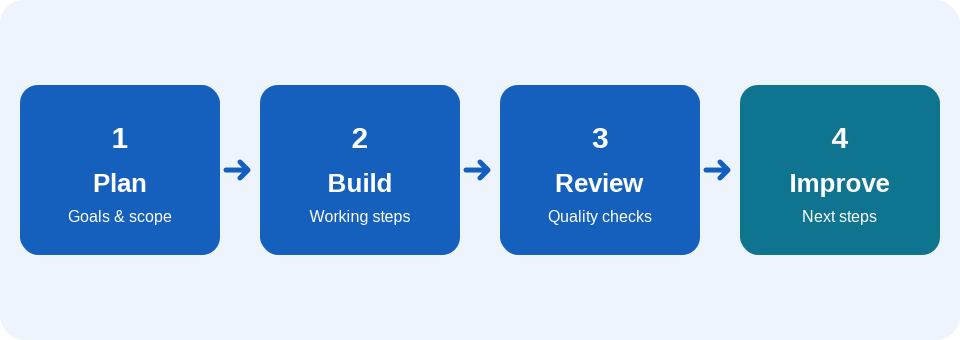
The reference lifecycle connects discovery, prototyping, development, and approved release. Delivery measures and documentation support review of progress without implying every sprint ships to production.
- Discover
- Prototype
- Build In Sprints
- Release & Support
Discover → Prototype → Build In Sprints → Release & Support.
This is a reference sequence. Access, staffing, timing, integrations, and service commitments follow the agreed engagement scope.
Getting Started
Define the outcome, baseline, affected systems, owners, access prerequisites, and constraints. Agree deliverables, measures, timeline, and commercial terms before work begins. Start with a focused assessment or pilot where appropriate; no universal delivery schedule applies.
How This Aligns With Current Industry Practice
Software priorities differ by industry.
| Industry | How this applies |
|---|---|
| Financial services | Secure customer and partner portals with strong audit trails |
| Manufacturing | Maintenance and quality workflow tools |
| Public sector | Accessible citizen facing services |
| Technology | Internal tools and integrations that scale with growth |
Delivery Principles
- Accountability. Named owners and clear decision rights.
- Evidence. Defined baselines, acceptance criteria, and explicit exceptions.
- Maintainability. Documented handover and operating responsibilities.
- Value for investment. Scope and commercial terms aligned to the decision or outcome.
Sample Return On Investment
The following are illustrative business-case measures, not verified client results or guaranteed returns.
| Measure | Illustrative target | How we track it |
|---|---|---|
| Release frequency | From quarterly to every few weeks | DORA deployment frequency |
| Manual process steps removed | 25 to 40 percent fewer | Steps and wait time per process |
| Security findings at release | None critical, open | Scan and test results |
Illustration only, based on assumed inputs. We build the real business case with your team during discovery, using your own baseline, and we report against it honestly, including where results fall short of the target.
Dependencies & Safeguards
Confirm system access, source quality, client approvals, specialist availability, provider dependencies, and scope boundaries early. Record unresolved risks and escalate failures explicitly. Industry examples identify requirements to assess, not certifications or evidence of completed client engagements.
Frequently Asked Questions
Do you follow an agile process?
Where appropriate, use short iterations with demonstrations and agreed acceptance criteria. Release timing depends on readiness and approvals, not solely on sprint completion.
Who owns the code?
Agree ownership of custom code, reusable components, third-party licenses, documentation, and support before work begins. Rights are determined by the contract and applicable licenses.
Can you work alongside our internal developers?
Yes. We often work as an extension of an existing team rather than a fully separate one.
How is pricing structured?
Pricing depends on scope: a fixed price for well defined work, a dedicated team on a monthly basis for ongoing capacity, or a managed service with agreed service levels for continuous operation. We agree the model and the number together during scoping, before any commitment is made.
Can we start with something smaller before committing to a full engagement?
A focused assessment or pilot may be appropriate where feasible. Agree its scope, evidence, availability, and decision gates before committing to a broader program.
Next Step
Have a process that still runs on spreadsheets and email? Reach us through the solution inquiry page.
Related: Quality engineering | Workflow applications | Web application development