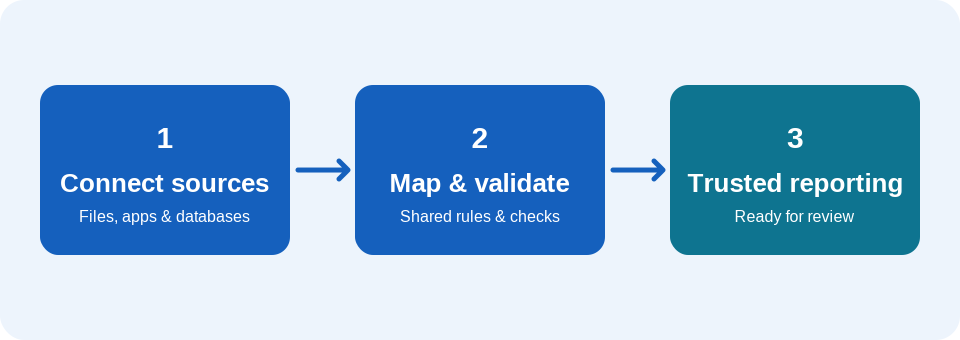
Why This Matters To Your Leadership Team
- Conflicting reports. The same metric comes out differently depending on who ran the query.
- Slow answers. A simple business question takes days because data lives in too many places.
- Fragile spreadsheets. Critical reporting depends on a manual process only one person understands.
A shared model can reduce conflicting reports when definitions, source quality, and operating controls are maintained.
What Is Included
The following are scope options, not automatic inclusions. Confirm availability, responsibilities, and acceptance criteria in the agreement.
- Source assessment. Inventory priority sources, owners, quality issues, and access prerequisites.
- Dimensional modeling. Define facts, dimensions, grain, history, and business measures.
- Automated pipelines. Implement agreed loads, validation, ownership, and alert routing.
- Historical load. Plan the approved history, retention, and reconciliation requirements.
- Documentation and training. Define handover material and the team's operating responsibilities.
Practical Delivery Considerations
Model & Reconcile
Agree grain, keys, slowly changing dimensions, late-arriving data, and metric definitions. Reconcile source totals and sampled values against accepted tolerances; a central store does not automatically make incorrect source data accurate.
Platform & Controls
Compare Snowflake, Databricks SQL, Microsoft Fabric, BigQuery, or Redshift against workloads, licensing, team skills, and residency needs. Record access roles, retention, lineage coverage, and recovery requirements.
Operate & Measure
Define refresh targets, freshness signals, exception handling, capacity, and cost allocation. Measure reporting effort and retired costs against a documented baseline, including transition and ongoing expenses.
Reference Delivery Process
A reference warehouse flow stages source data, validates and conforms it, then serves agreed business models. The selected platform and reconciliation gates follow workload and governance requirements.
- Source Systems
- Stage & Clean
- Model & Load
- Report & Serve
Source Systems → Stage & Clean → Model & Load → Report & Serve.
This is a reference sequence. Access, staffing, timing, integrations, and service commitments follow the agreed engagement scope.
Getting Started
Define the outcome, baseline, affected systems, owners, access prerequisites, and constraints. Agree deliverables, measures, timeline, and commercial terms before work begins. Start with a focused assessment or pilot where appropriate; no universal delivery schedule applies.
How This Aligns With Current Industry Practice
A well built warehouse pays off differently depending on your sector.
| Industry | How this applies |
|---|---|
| Financial services | Supports regulatory reporting with lineage back to the source |
| Retail | Unifies sales across store, web, and marketplace channels |
| Manufacturing | Brings plant and ERP data into one reporting layer |
| Healthcare | Combines operational and financial views under strict access control |
Delivery Principles
- Accountability. Named owners and clear decision rights.
- Evidence. Defined baselines, acceptance criteria, and explicit exceptions.
- Maintainability. Documented handover and operating responsibilities.
- Value for investment. Scope and commercial terms aligned to the decision or outcome.
Sample Return On Investment
The following are illustrative business-case measures, not verified client results or guaranteed returns.
| Measure | Illustrative target | How we track it |
|---|---|---|
| Report preparation time | 30 to 50 percent less | Hours per reporting cycle |
| Legacy reporting tools retired | One or more consolidated | Licenses and servers decommissioned |
| Time to answer an ad hoc question | From days to hours | Time from request to answer |
Illustration only, based on assumed inputs. We build the real business case with your team during discovery, using your own baseline, and we report against it honestly, including where results fall short of the target.
Dependencies & Safeguards
Confirm system access, source quality, client approvals, specialist availability, provider dependencies, and scope boundaries early. Record unresolved risks and escalate failures explicitly. Industry examples identify requirements to assess, not certifications or evidence of completed client engagements.
Frequently Asked Questions
How long does a first warehouse build take?
Agree the first-release schedule after assessing source access, data quality, history, model complexity, and approvals.
Do we need to pick one cloud platform?
Assess formats, integrations, and contractual constraints before selecting a platform. Open formats can reduce some switching costs but do not guarantee portability of every feature or workload.
Can you work with our existing BI tool?
Yes. We build the warehouse to feed the reporting tools you already use, such as Power BI, Tableau, or Looker.
How is pricing structured?
Pricing depends on scope: a fixed price for well defined work, a dedicated team on a monthly basis for ongoing capacity, or a managed service with agreed service levels for continuous operation. We agree the model and the number together during scoping, before any commitment is made.
Can we start with something smaller before committing to a full engagement?
A focused assessment or pilot may be appropriate where feasible. Agree its scope, evidence, availability, and decision gates before committing to a broader program.
Next Step
Want one trusted set of numbers across your business? Reach us through the solution inquiry page.
Related: Data migration | Analytics & reporting | Data governance